
Fertility and Modernity
This is a problem and we have no idea how to fix it.

France has been in the news lately. Not just because Brigitte Macron is suing Candace Owens. Apparently, the land of berets and baguettes has reached a bit of a demographic milestone. For the first time since the Second World War, deaths outnumber births in France. The country with the healthiest demographics in Europe now has a fertility rate of 1.56 children per woman. This is slightly lower than the 1.6 rate for the United States, home of yours truly. As a reminder, the replacement rate is 2.1 children per woman.
I’ve been thinking a lot about this recently, especially since I gave birth to my first child several weeks ago. This is just one of the ways that I am an outlier amongst my peer group. For reference, I’m a Gen Z girl living in a large coastal city in the United States. Most of the other girls my age that I know are not even in committed relationships, let alone married with a kid like me. A majority of them seem to languish in the depths of the dreaded ‘situationship’.
The wounds seem to be self-inflicted, though. Only about 45% of women in the USA aged 18 to 34 say that they want children, whereas just less than two-thirds of men that age do. Around 30% of Gen Z women specifically don’t want kids. Of the Gen Z girls that I know, those who do say they want kids are really vague about when they want that to happen.
Why is this though? There are a lot of theories out there. I thought it might be interesting to go through some of them and offer my take.
But is this even really a problem? Aren’t there too many people on planet Earth already anyway? That was the message that was conveyed to me when I was in college. The thought was that it was irresponsible to bring children into a world where climate change is accelerating. As if human beings were some type of parasite or cancer, slowly killing the host.
Granted, there have been population collapses before. It happened throughout the classical world as the Roman Empire imploded. The Black Death famously killed half of Europe. But it’s different this time because we live in a modern industrial society.
As Peter Zeihan is fond of saying, you can’t have economic growth if there is no consumption. And it’s the young who consume. We are the ones buying cars and houses while the boomers age into irrelevance. But there are fewer and fewer young people.
Zeihan’s explanation for demographic changes is fairly simple. If you live on a farm, kids are cheap labor, so you have as many of them as you can. When a nation industrializes, people move to cities and live in apartments and work in factories. Children become expensive luxuries, so people naturally have fewer of them.
I think that he is broadly correct, but the picture is a bit more nuanced. There are certainly cultural factors at play. Pro-natalists tend to be towards the right side of the political spectrum, with many conservatives such as Elon Musk, J.D. Vance, Malcolm and Simone Collins, and the late Charlie Kirk being prominent examples. Women who identify as conservative are more likely to desire or have children. My own personal politics do not fit well into the traditional right/left paradigm.
The solution is not what is practiced in many parts of the world outside of the West. Women will, of course, have more children if you don’t let them leave the house. In the West, the trad-wife meme has mostly played out (or at least morphed into something else).
I think that the availability of reliable birth control is most certainly a good thing. I am also pro-choice. Returning to the Norman Rockwell myth of the mid-century is not something that is probable or even possible. However, living in ‘The Longhouse’ is certainly not a preferable alternative.
One of my favorite authors and podcasters is Louise Perry. I find her to be one of the most intelligent, insightful, and erudite women on the internet. Of course, I also listen to Alex Cooper’s podcast, so there is no accounting for taste. For shits and giggles, listen to an episode of ‘Maiden Mother Matriarch’ and then an episode of ‘Call Har Daddy’ right after that. The intellectual whiplash will make your head spin.
Louise Perry is often accused of being an anti-feminist, but I don’t feel that way about her at all. Her discussions (debates?) with other women who identify as feminist are generally quite illuminating, but I feel as though many times the feminists whom she talks to are not really listening and then try to talk past her. Perry is a feminist in that she seems to genuinely want what’s best for women, but she is not hamstrung by mainstream progressive ideology. I like to think of myself as a kindred spirit.
I remember seeing one roundtable discussion in which a feminist author was using the example of the television show ‘Mad Men’ to explain the plight of women in the mid-twentieth century and how lousy their lives were. I looked high and low for the link to this video, but I could not find it (I swear it exists).
I really do not think that this is a good example. Don Draper is a narcissistic, alcoholic sociopath who torpedoes every relationship that he’s in. He treats Betty like shit, cheating on her and even calling her psychiatrist at one point to spy on what she talks about in therapy. I will concede that there would have been no expectation that Betty would ever have any kind of a career outside the home. Her opportunities would have been much more limited than mine since I have grown up in the 21st century. I would not want to switch places with Betty even if Don were the best husband ever.
The other thing that strikes me about Mad Men as I reconsider it is how much stuff we have compared to the Drapers. Don seems to make a good living, and the home is in a nice neighborhood. However, Sally and Bobby share a room, which would be unthinkable for an upper-middle-class family today. Don doesn’t even own a car when the series kicks off.
This is another possible reason for falling birth rates. The barrier to entry is too high if a couple is going to give a child what’s considered an acceptable upbringing. Although this theory is contradicted by statistics that show the largest fertility rates in the highest and lowest income quintiles. There appears to be a dip in the middle, so maybe parenthood is only cost-prohibitive to those who are striving to raise their economic status?
Another noticeable aspect of Mad Men is that neither Sally nor Bobby are involved in any significant extracurricular activities outside of school. These days, parents are glorified cruise directors or chauffeurs, continuously shuttling children to Scouts or dance practice or soccer games. It makes parenting a lot easier when a mom or dad doesn’t have to spend so much time after work keeping their kids occupied. Once again, these days, a mom would be doing a bad job if she is not helping her children pad their resumes.
When I was growing up, I was a bit of an anomaly because I wasn’t involved in really any after-school activities. I essentially had a deal with my parents that if my grades were good, they would let me do what I wanted with my own time. I remember interacting somewhat with other kids in the neighborhood and at school, but I mostly kept to myself. I got bullied a lot, so that may have had a bit to do with it. I was the girl with the glasses who was always sitting by herself reading a book.
I don’t remember ever being lonely, though. Reading and playing video games kept me entertained. I learned how to play the guitar from my dad when I was pretty young and then just started teaching myself more and more by consulting the internet. I never took any formal guitar lessons. I also loved collecting and arranging my Pokémon cards, but I hardly ever actually played the card game with anyone else.
It’s easy to get caught up in the achievement trap, isn’t it? There are times I catch myself catastrophizing and thinking things like if my son doesn’t get into the right elementary school, then he won’t get into the right high school, and then he won’t get into the right college, and then he won’t be able to get a good job and will end up giving hand jobs for crack behind a Walmart.
Even if time, effort, and expense don’t keep people from having children, narcissism certainly can. There was an article in Vogue a while back entitled ‘Is Having a Boyfriend Embarrassing Now?’. The article was pretty silly, although it dominated internet chatter for a hot minute. Hiding your man is framed as solidarity with single women, but I think that it highlights just how commodified we all are now. When your brand is all about travel, Pilates, fancy cocktails, and mani-pedis, it’s hard to find space for motherhood in all of that. Yes, I know that there are ‘parenting influencers’ as well, but they are not that common if we’re being honest.
Rob Henderson, another writer and podcaster whose content I thoroughly enjoy, posted an essay on this topic that had a novel take. Dr. Henderson writes about ‘Girlboss Gatekeeping,’ where encouraging other women to forgo having children and focus on their careers may be an evolutionary strategy to keep the number of children low so that there are more resources available for one’s own. I can relate to this since when I was in college, everyone talked about what they wanted their careers to be, but it seemed almost verboten to mention starting a family.
Similarly, when I was in college, there was all this talk about how traditional family structure was inherently patriarchal and stifling towards women, and that we needed to move past or do away with marriage as an institution. The people who talked like this were college kids from upper-middle families who were raised by a married mother and father. This plays into another concept from Dr. Henderson called ‘luxury beliefs’. Basically, these are beliefs that confer status on the people that express them but actually would make things worse for the underprivileged if they were implemented.
I’ve come to realize that so many of the things that we were told or that I used to believe ended up being untrue. That people are born as a ‘blank slate’. That men and women are the same. That human beings, and by extension, societies are perfectible. That variation in outcomes must be the result of oppression.
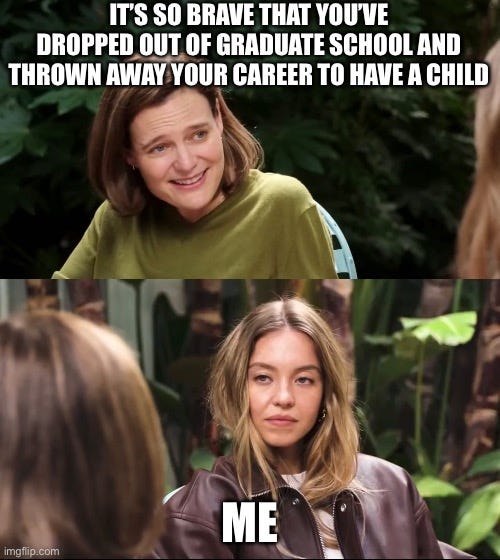
If you had talked to me in college, I would have said that I had no interest in marriage or a family. I was all about my career. Things change, though. I met a guy, fell in love, got married, and soon enough, had a baby. I thought that dropping out of my PhD program would have felt more traumatic, but I actually didn’t stress about it all that much. I guess technically I’m on sabbatical, and I could go back eventually, but I probably won’t. I’ve come to realize that lack of ambition doesn’t make me a bad person. I simply have different priorities now. The fact that I’ll never have the word ‘doctor’ in front of my name doesn’t sting that much.
I’m still a little sore from having that kid pulled out of me. The labor wasn’t that bad since I had an epidural, but after the anesthesia wore off, the pain is no joke. I can sit down normally now, but it took a while. Not that I’m whining. It’s just that pregnancy and childbirth can be difficult, and I think that, in all fairness, we need to acknowledge that.
I’m lucky in that my husband and I both have good jobs. Mine is quite flexible, and my boss has been very accommodating about me working from home and working part-time. Not that many people can say that. A brief return to the ‘girlboss gatekeeping’—I’m really glad my boss is a man. Indeed, I work in STEM, and the majority of people that I work with and in my field in general are men. Of course, things tend to get much shittier when women take them over.
A final thought on fertility has to do with the fact that for a significant portion of young women, it would be embarrassing to be a stay-at-home mom. Choosing motherhood many times means not choosing status. At least not in the way that current society defines it. If you’re wealthy and don’t have to work, then having lots of kids can be a flex, but most people aren’t in that situation. I don’t think that having working parents is bad for kids. In addition to my father working full time, my mother worked a full-time job throughout most of my childhood. It’s probably more important that kids grow up in an intact family with both a mother and a father in the household.
I don’t have any great ideas about how to reorient society and culture to raise fertility, and everyone has to choose their own path. I just figured I would share my own experiences.
Congratulations on your child. It seems very common that women if they find the right guy want children, when they think they did. Birth and motherhood are hard but also beautiful and the contrast adds meaning.
Good article. Congratulations on your child.
Just one question, if I may.
Given that you have experienced the joy and meaning of your baby, and seem be to pro Natalist (or at least not anti natalist), how do you square that with being pro choice?
Now that you know the joy and purpose of motherhood, could you conceptualize of Uhm, (I'll try to find the nicest word here) "eliminating" your baby while he or she was growing?